

How To Draw Circuits In Latex
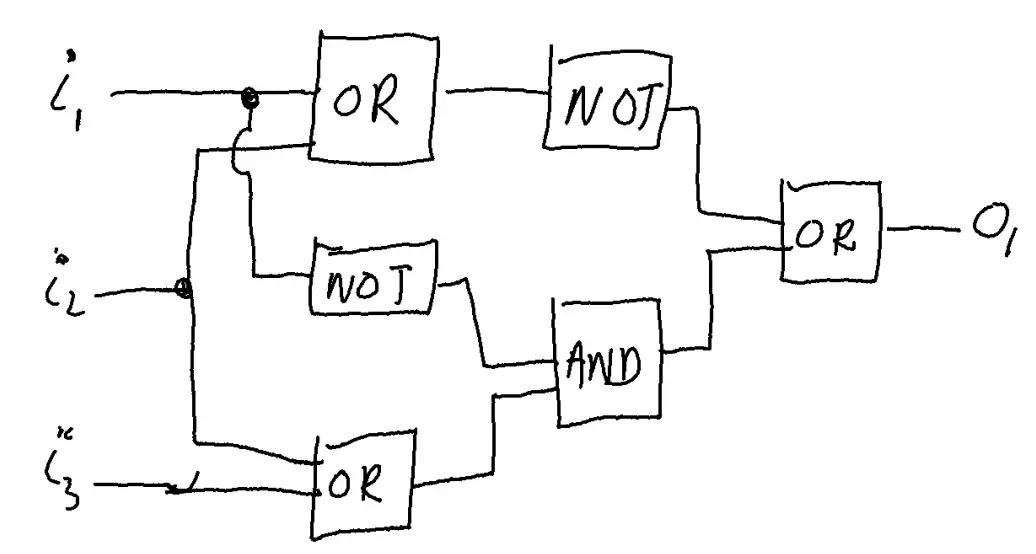
Hand fatigued circuit suggested by Nithin Aaron
If yous enjoy these TikZ tutorials, Please consider supporting me by ownership me a java 

Short description
LaTeX code of the Logic circuit: IEEE style
\documentclass[border=0.2cm]{standalone} % Required packages and libraries \usepackage{circuitikz} \usetikzlibrary{calc} \begin{document} \begin{tikzpicture} % Excursion style \ctikzset{ logic ports=ieee, logic ports/calibration=0.eight, logic ports/fill=lightgray } % Logic ports \node[or port] (ORa) at (0,0){}; \node[not port] (Noa) at (0,-2){}; \node[or port] (ORb) at (0,-4){}; \node[not port] (Nob) at (2.v,0){}; \node[and port] (ANDa) at (2.5,-3){}; \node[or port] (ORc) at (5,-1.5){}; % Connection \describe (ORa.out) -- (Nob.in); \draw (Noa.out) -| (ANDa.in 1); \draw (ORb.out) -| (ANDa.in 2); \draw (ANDa.out) -| (ORc.in 2); \describe (Nob.out) -| (ORc.in 1); \draw (ORc.out) -- ++(i,0) node[nigh end,above]{Out}; \draw (ORa.in 1) -- ++(-one.5,0)node[left](In1){In1}; \describe (ORb.in 2) -- ++(-1.5,0)node[left](In3){In3}; % Jump crossing chemical element \node at (ORa.in ii) [ below, jump crossing, rotate=-90, scale=one.3 ](Ten){}; \depict (Noa.in) -| (X.eastward) (X.west) to[short,-*] (Ten.westward |- ORa.in 1); \draw ($ (In1) !.5! (In3) $) node[]{In2} ++ (0.4,0) to[curt,-*] ++(0.v,0) coordinate(a) |- (X.south) (a) |- (ORb.in 1); \finish{tikzpicture} \end{document} Compiling the to a higher place code yields:
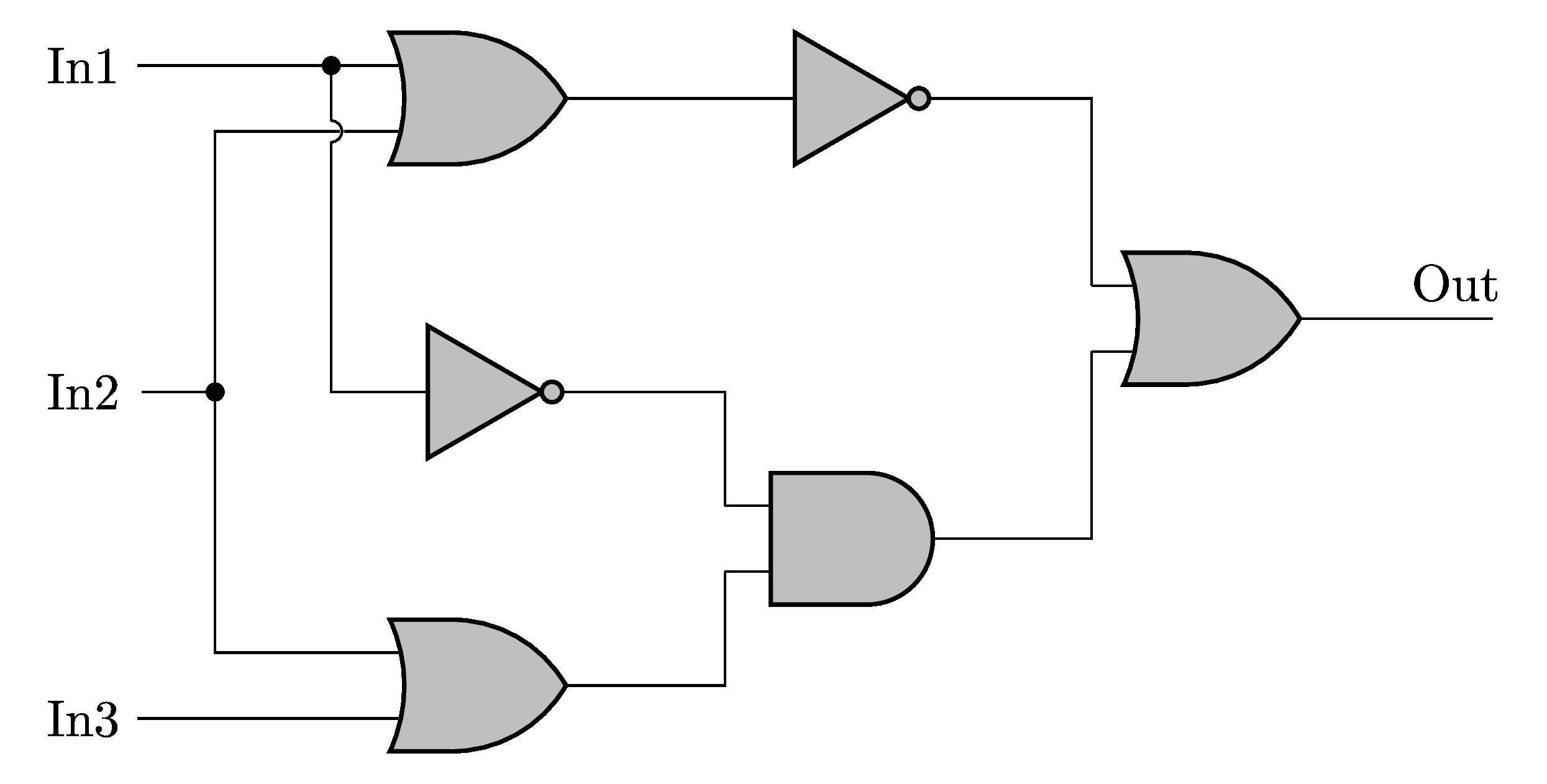
Logic Excursion in CircuitikZ with IEEE components style
LaTeX code of the Logic circuit: American manner
Past changing the style from ieee to american in the to a higher place code, we will become:
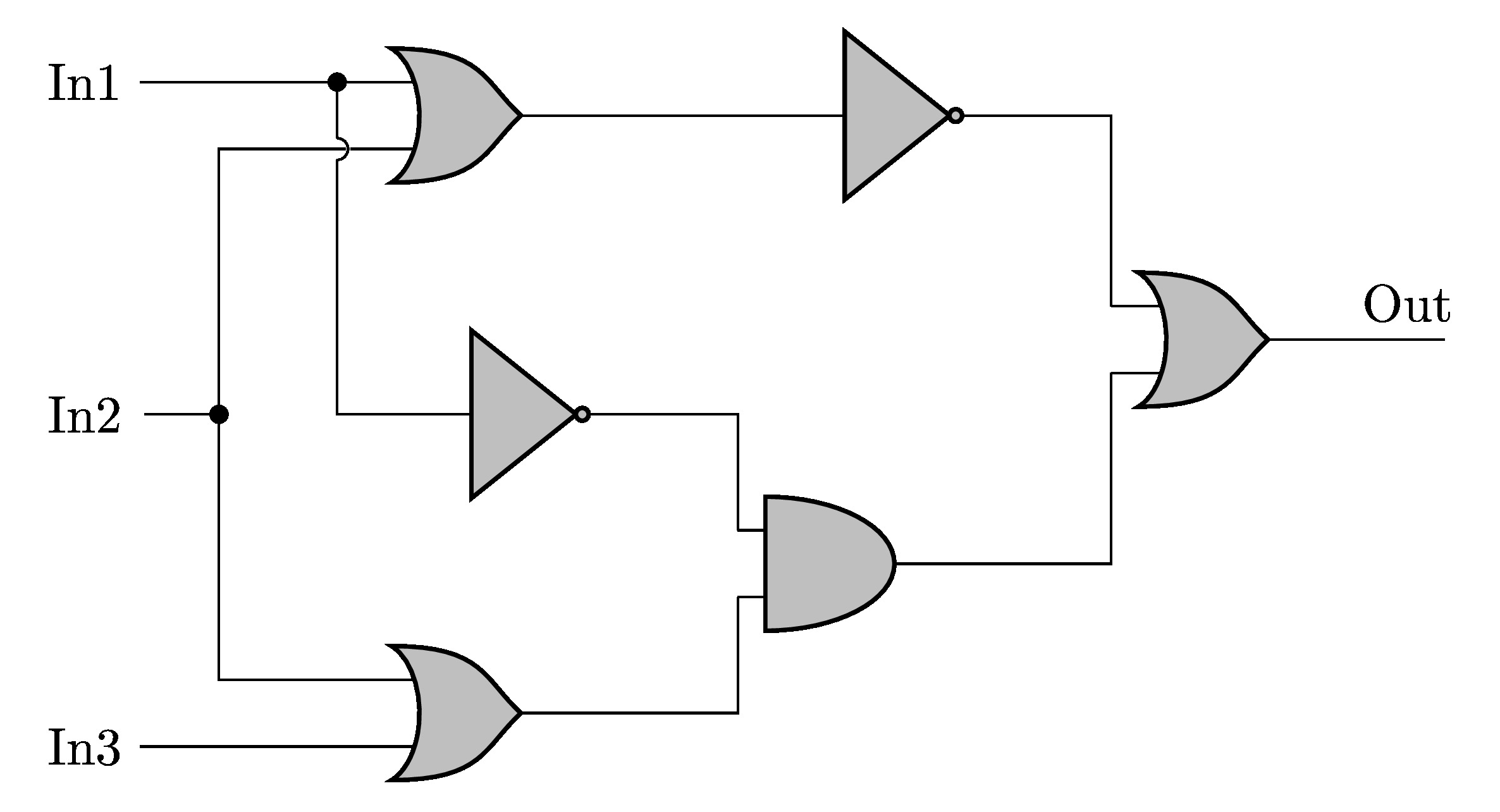
Logic Circuit in CircuitikZ with American components mode
LaTeX code of the Logic circuit: European way
Past irresolute the style from ieee to european in the higher up code, we volition get:
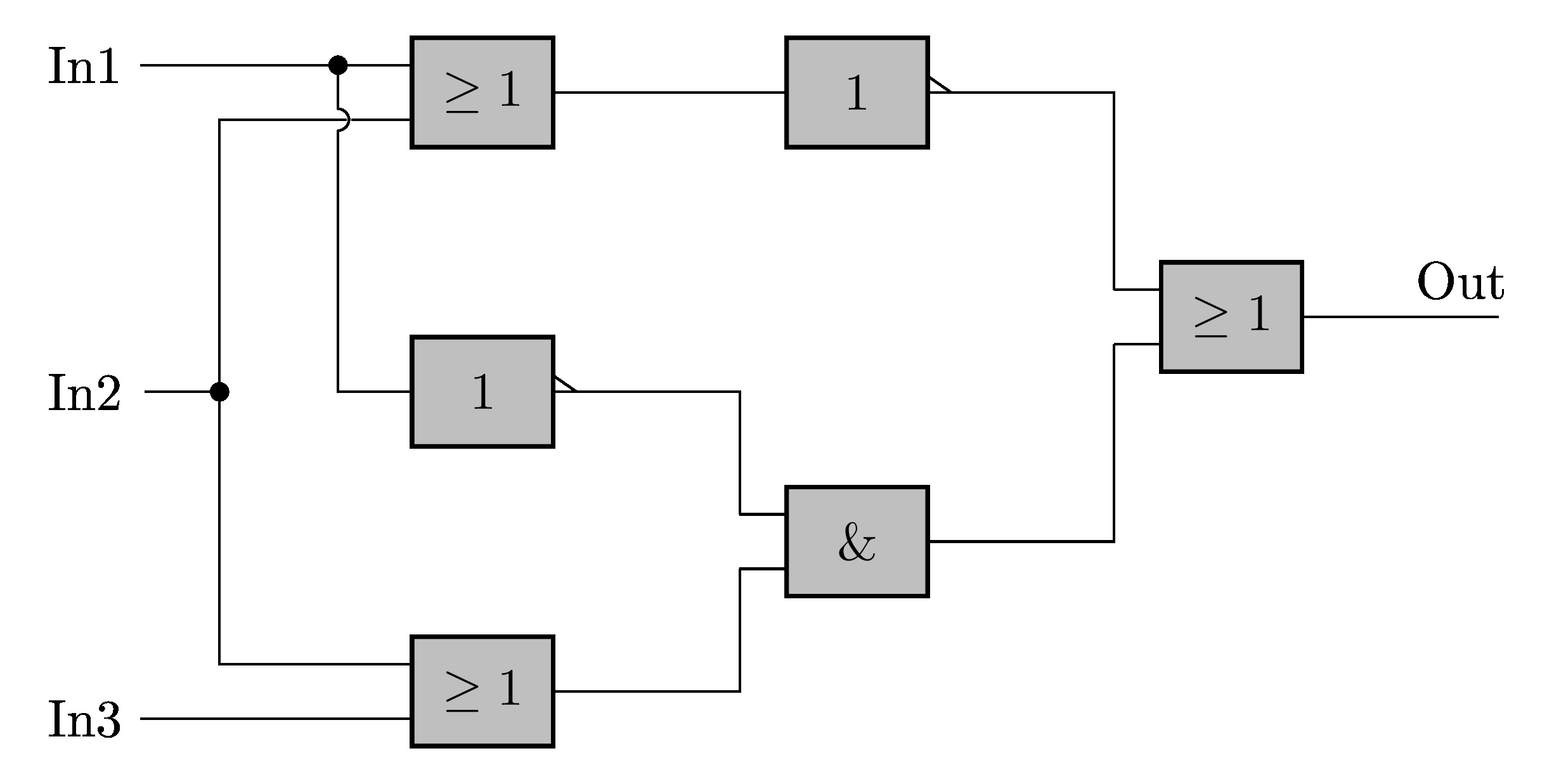
Logic Circuit in CircuitikZ with European components fashion

Source: https://latexdraw.com/draw-a-logic-circuit-in-circuitikz/
Posted by: covarrubiasdond1949.blogspot.com
0 Response to "How To Draw Circuits In Latex"
Post a Comment